VII.
We’ve spent time this week noticing what this passage has to say about praise, worship and salvation.
As we spend time with it today, pay attention to the closing words of the passage and see how they complement what is written about praise, worship and salvation.
For this reason they are before the throne of God,
and worship him day and night within his temple,
and the one who is seated on the throne will shelter them.They will hunger no more, and thirst no more;
the sun will not strike them,
nor any scorching heat;for the Lamb at the center of the throne will be their shepherd,
and he will guide them to springs of the water of life,
and God will wipe away every tear from their eyes.
VIII.
Revelation 7:9-17 (NRSV)
After this I looked, and there was a great multitude that no one could count, from every nation, from all tribes and peoples and languages, standing before the throne and before the Lamb, robed in white, with palm branches in their hands. They cried out in a loud voice, saying,
“Salvation belongs to our God who is seated on the throne, and to the Lamb!”
And all the angels stood around the throne and around the elders and the four living creatures, and they fell on their faces before the throne and worshiped God, singing,
“Amen! Blessing and glory and wisdom
and thanksgiving and honor
and power and might
be to our God forever and ever! Amen.”Then one of the elders addressed me, saying, “Who are these, robed in white, and where have they come from?” I said to him, “Sir, you are the one that knows.” Then he said to me, “These are they who have come out of the great ordeal; they have washed their robes and made them white in the blood of the Lamb.
For this reason they are before the throne of God,
and worship him day and night within his temple,
and the one who is seated on the throne will shelter them.They will hunger no more, and thirst no more;
the sun will not strike them,
nor any scorching heat;for the Lamb at the center of the throne will be their shepherd,
and he will guide them to springs of the water of life,
and God will wipe away every tear from their eyes.”
IX.
f As I approach the Book of Revelation I come to it with the understanding that it was written for disciples of Jesus in the late first century and early second century who were being disadvantaged and even persecuted for their claiming Jesus as their Lord and refusing to bow to the lordship of any other. It was written to offer them encouragement and hope. Can it do the same for us who stand some twenty centuries apart from those disciples? Do we still need one to shepherd us? Do we still need one to guide us to springs of the water of life? Do we still trust that God can wipe away every tear? Can we trust that his shepherding us, guiding us, and consoling us is not something that is postponed to the other side of the grave, but can be something we experience even now? I pray so. I also pray that we can find the way to be part of that shepherding, guiding and consoling for one another even today. charles IV. V. After this I looked, and there was a great multitude that no one could count, from every nation, from all tribes and peoples and languages, standing before the throne and before the Lamb, robed in white, with palm branches in their hands. They cried out in a loud voice, saying, “Salvation belongs to our God who is seated on the throne, and to the Lamb!” And all the angels stood around the throne and around the elders and the four living creatures, and they fell on their faces before the throne and worshiped God, singing, “Amen! Blessing and glory and wisdom Then one of the elders addressed me, saying, “Who are these, robed in white, and where have they come from?” I said to him, “Sir, you are the one that knows.” Then he said to me, “These are they who have come out of the great ordeal; they have washed their robes and made them white in the blood of the Lamb. For this reason they are before the throne of God, They will hunger no more, and thirst no more; for the Lamb at the center of the throne will be their shepherd, VI. What national, tribal and language groups is the multitude limited too? Why? What do you hear them saying? To your thinking, how does this passage describe the “salvation” the multitude speaks of? charles I. Sometimes just a mention of the Book of Revelation will have folks turning away if not running away. I invite you to put aside any preconceived notions about the book and approach these passages with an open mind, ready to take in what each has to say about praise and worship. Let me suggest you read this week’s passage, then give yourself a few minutes for it to soak in somewhat. Then reread it paying attention to who is mentioned and again resting with this. Then a third reading paying attention to what what each person and group says (or sings), Let’s begin – II, After this I looked, and there was a great multitude that no one could count, from every nation, from all tribes and peoples and languages, standing before the throne and before the Lamb, robed in white, with palm branches in their hands. They cried out in a loud voice, saying, “Salvation belongs to our God who is seated on the throne, and to the Lamb!” And all the angels stood around the throne and around the elders and the four living creatures, and they fell on their faces before the throne and worshiped God, singing, “Amen! Blessing and glory and wisdom Then one of the elders addressed me, saying, “Who are these, robed in white, and where have they come from?” I said to him, “Sir, you are the one that knows.” Then he said to me, “These are they who have come out of the great ordeal; they have washed their robes and made them white in the blood of the Lamb. For this reason they are before the throne of God, They will hunger no more, and thirst no more; for the Lamb at the center of the throne will be their shepherd, III. How does it strike you? Do you think it would be fitting for a “Call to Worship” or benediction, an opening or closing prayer in congregations you might be familiar with? Would you be comfortable saying or singing these words with others assembled to worship? Why don’t you “try it on”? Repeat it a few times. What most draws you to it or pushes you away from it? And, remember, it is ok if it is not to your personal taste. In either case, give yourself some time to consider how it strikes you? charles VII. VIII. Praise the Lord! Let Israel be glad in its Maker; Let them praise his name with dancing, For the Lord takes pleasure in his people; Let the faithful exult in glory; Psalm 150 (NRSV) Praise the Lord! Praise him for his mighty deeds; Praise him with trumpet sound; Praise him with tambourine and dance; Praise him with clanging cymbals; Let everything that breathes praise the Lord! IX. During these weeks we have spent with the Psalms, what might we have learned about “how to enter them”? We have learned they speak of praise to and for The Lord God. Does hearing them speak of praise help us find ways to express our desire to praise? And might they even help us when we do not have the desire to praise or have words of praise? I am not thinking that we should only repeat their words but that we can listen to their words and try to find their paths to praise. Maybe seeing how they walked toward praise can serve as a map for us. And don’t forget the Psalms can express disappointment and anger. They can be very explicit in such expressions. Maybe taking note of their honesty with God can help us move to such honesty. The Psalms are not “flat” praise songs, but multidimensional expressions of very human emotions as they seek to encounter God and as they find reality in that encounter. charles IV. “ … the Psalms are the nourishment of [the] interior life and of … personal prayer, so that at last [we] come to live them and experience them as if they were [our] own songs, [our] own prayers.” Spend time today with these two Psalms, taking special note of where they are your own songs, your own prayers. V. Praise the Lord! Let Israel be glad in its Maker; Let them praise his name with dancing, For the Lord takes pleasure in his people; Let the faithful exult in glory; Psalm 150 (NRSV) Praise the Lord! Praise him for his mighty deeds; Praise him with trumpet sound; Praise him with tambourine and dance; Praise him with clanging cymbals; Let everything that breathes praise the Lord! VI. For those days in which praise does not seem to naturally arise, what do you do? Do you fake it? Do you avoid God? Do you offer your honesty to God in the place of the absent praises? What can you do? charles I. Spend some time with these Psalms and notice what holds your attention. II. Praise the Lord! Let Israel be glad in its Maker; Let them praise his name with dancing, For the Lord takes pleasure in his people; Let the faithful exult in glory; Psalm 150 (NRSV) Praise the Lord! Praise him for his mighty deeds; Praise him with trumpet sound; Praise him with tambourine and dance; Praise him with clanging cymbals; Let everything that breathes praise the Lord! III. In other words, the more often words occur in the selected text, the larger the word appears. A possible word cloud representation of this week’s Scripture would be – Does that paint an accurate picture of how you hear these Psalms? Is your attention drawn to the word(s) most repeated, or is it drawn to something else? Maybe something you hear in the spirit of the Psalmist that leads him to offer this song to God and to us? charles VII. Happy are those whose strength is in you, As they go through the valley of Baca They go from strength to strength; As you turn to the Psalm for another meditative reading, let these words be your lens for hearing the Psalm – in whose heart are the highways to Zion. VIII. How lovely is your dwelling place, My soul longs, indeed it faints Even the sparrow finds a home, Happy are those who live in your house, Happy are those whose strength is in you, As they go through the valley of Baca They go from strength to strength; O Lord God of hosts, hear my prayer; Behold our shield, O God; For a day in your courts is better For the Lord God is a sun and shield; O Lord of hosts, IX. Is this Psalm a song of praise for the Temple or a song of praise that sees beyond the Temple and takes us beyond the Temple? Happy are those whose strength is in you, Where does the heart lead? What path does the heart make for us? X. Even the sparrow finds a home, charles IV. Does it seem that way to you? As you spend time with the Psalm today, pay attention to the “place” (and places) it names. V. How lovely is your dwelling place, My soul longs, indeed it faints Even the sparrow finds a home, Happy are those who live in your house, Happy are those whose strength is in you, As they go through the valley of Baca They go from strength to strength; O Lord God of hosts, hear my prayer; Behold our shield, O God; For a day in your courts is better For the Lord God is a sun and shield; O Lord of hosts, IV. What do you think those singing the Psalm with the Psalmist so many centuries ago have in their minds as they sang. What would they see either around them, or in their mind’s eye. I guess you could remind me that all those questions could be answered differently depending on the Psalm being sung in the era of a wilderness tabernacle, or Solomon’s Temple, of post-temple exile, of synagogue centered life in exile or in post-exile Israel, or of Herod’s Temple, or of post Second Temple or in the diaspora. And you would be right. As the Psalm is sung are their thoughts about the place in which they sing and praise or could their song also have grief for a place they no longer inhabit? What of you and me? Do you know a place of praise and worship you no longer can reach? A place beyond your reach? How do you still worship and praise if “that” place is lost? charles I. The Psalmist opens with – How lovely is your dwelling place, As you spend time with this Psalm and read it several times, notice what is claimed to be The Lord’s “dwelling place.” II. Psalm 84 (NRSV) How lovely is your dwelling place, O Lord of hosts! My soul longs, indeed it faints for the courts of the Lord; my heart and my flesh sing for joy to the living God. Even the sparrow finds a home, and the swallow a nest for herself, where she may lay her young, at your altars, O Lord of hosts, my King and my God. Happy are those who live in your house, ever singing your praise.Selah Happy are those whose strength is in you, in whose heart are the highways to Zion. As they go through the valley of Baca they make it a place of springs; the early rain also covers it with pools. They go from strength to strength; the God of gods will be seen in Zion. O Lord God of hosts, hear my prayer; give ear, O God of Jacob! Selah Behold our shield, O God; look on the face of your anointed. For a day in your courts is better than a thousand elsewhere. I would rather be a doorkeeper in the house of my God than live in the tents of wickedness. For the Lord God is a sun and shield; he bestows favor and honor. No good thing does the Lord withhold from those who walk uprightly. O Lord of hosts, happy is everyone who trusts in you. III. Where are the “courts of the Lord”? The “alters” are mentioned as a safe place for sparrows and swallows to nest and “lay [their] young.” The “courts” of God are mentioned and likewise the “[door] in the house of God.” Why is the Psalmist content to be a “doorkeeper in the house of … God”? Maybe he should expect a “better” job for himself in God’s courts? When you read these expressions of “where” God dwells, what comes to mind for you? What do you see? charles Let those who are wise give heed to these things, VIII. As you read Psalm 107 once again, pause as the Psalmist offers examples of The Lord’s “steadfast love.” Do the examples give you cause to consider your own experience of God’s love? IX. Psalm 107:1-9 (NRSV) O give thanks to the Lord, for he is good; Let the redeemed of the Lord say so, and gathered in from the lands, Some wandered in desert wastes, hungry and thirsty, Then they cried to the Lord in their trouble, he led them by a straight way, Let them thank the Lord for his steadfast love, For he satisfies the thirsty, Psalm 107:39-43 (NRSV) When they are diminished and brought low he pours contempt on princes but he raises up the needy out of distress, The upright see it and are glad; Let those who are wise give heed to these things, X. redeemed from trouble Does the Psalmist lead you to a time of thanksgiving? charles
and he will guide them to springs of the water of life,
and God will wipe away every tear from their eyes.
{ubi caritas et amor, Deus ibi est}
As we return to this passage, let’s give some attention to how the “elder” describes the “great multitude.”
Revelation 7:9-17 (NRSV)
and thanksgiving and honor
and power and might
be to our God forever and ever! Amen.”
and worship him day and night within his temple,
and the one who is seated on the throne will shelter them.
the sun will not strike them,
nor any scorching heat;
and he will guide them to springs of the water of life,
and God will wipe away every tear from their eyes.”
So who is in the “great multitude”?
{ubi caritas et amor, Deus ibi est}
We continue to reflect on “praise” and for this week and the following two weeks we will spend time with three passages from the Book of Revelation.
Revelation 7:9-17 (NRSV)
and thanksgiving and honor
and power and might
be to our God forever and ever! Amen.”
and worship him day and night within his temple,
and the one who is seated on the throne will shelter them.
the sun will not strike them,
nor any scorching heat;
and he will guide them to springs of the water of life,
and God will wipe away every tear from their eyes.”
What is the “worship” song that the angels, elders and four creatures sing?
{ubi caritas et amor, Deus ibi est}
Again, in Bread in the Wilderness, Thomas Merton writes –
“The Psalms acquire, for those who know how to enter into them, a surprising depth, a marvelous and inexhaustible actuality. They are bread, miraculously provided by Christ,to feed those who have followed Him into the wilderness.”
Psalm 149:1-5 (NRSV)
Sing to the Lord a new song,
his praise in the assembly of the faithful.
let the children of Zion rejoice in their King.
making melody to him with tambourine and lyre.
he adorns the humble with victory.
let them sing for joy on their couches.
Praise God in his sanctuary;
praise him in his mighty firmament!
praise him according to his surpassing greatness!
praise him with lute and harp!
praise him with strings and pipe!
praise him with loud clashing cymbals!
Praise the Lord!
… for those who know how to enter into them …
{ubi caritas et amor, Deus ibi est}
In Thomas Merton’s Bread in the Wilderness, I came across this –
Psalm 149:1-5 (NRSV)
Sing to the Lord a new song,
his praise in the assembly of the faithful.
let the children of Zion rejoice in their King.
making melody to him with tambourine and lyre.
he adorns the humble with victory.
let them sing for joy on their couches.
Praise God in his sanctuary;
praise him in his mighty firmament!
praise him according to his surpassing greatness!
praise him with lute and harp!
praise him with strings and pipe!
praise him with loud clashing cymbals!
Praise the Lord!
As these Psalms become your own songs and prayers, where do you praise God, for what do you praise God, with what instruments (musical or otherwise) do you praise God?
{ubi caritas et amor, Deus ibi est}
This week we turn to the last two Psalms in the Book of Psalms, as we also end our time with the book of Psalms for now.
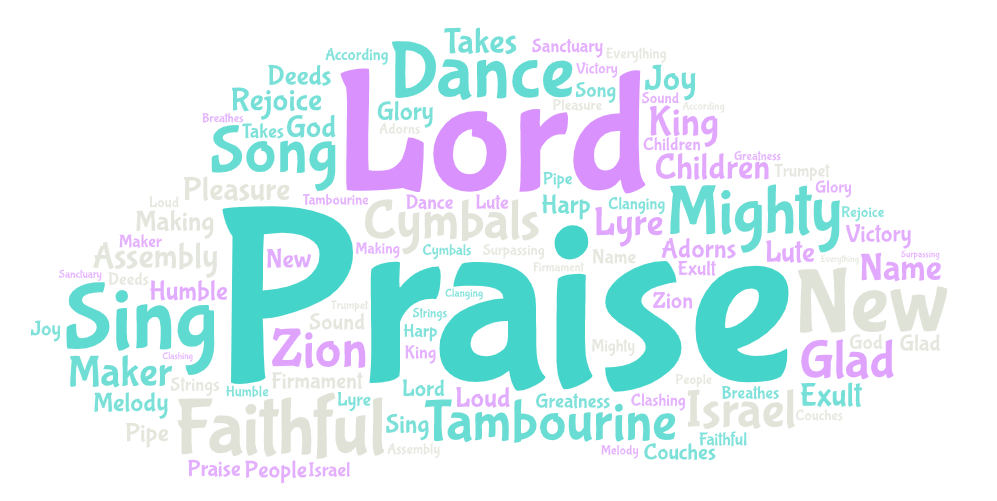
Psalm 149:1-5 (NRSV)
Sing to the Lord a new song,
his praise in the assembly of the faithful.
let the children of Zion rejoice in their King.
making melody to him with tambourine and lyre.
he adorns the humble with victory.
let them sing for joy on their couches.
Praise God in his sanctuary;
praise him in his mighty firmament!
praise him according to his surpassing greatness!
praise him with lute and harp!
praise him with strings and pipe!
praise him with loud clashing cymbals!
Praise the Lord!
Are you familiar with a “word cloud”? A word cloud is a visual representation of words that give greater prominence to words that appear more frequently in a selected text.
{ubi caritas et amor, Deus ibi est}
As we begin our time with this Psalm today, rest in these words from the Psalmist –
in whose heart are the highways to Zion.
they make it a place of springs;
the early rain also covers it with pools.
the God of gods will be seen in Zion.
Psalm 84 (NRSV)
O Lord of hosts!
for the courts of the Lord;
my heart and my flesh sing for joy
to the living God.
and the swallow a nest for herself,
where she may lay her young,
at your altars, O Lord of hosts,
my King and my God.
ever singing your praise.Selah
in whose heart are the highways to Zion.
they make it a place of springs;
the early rain also covers it with pools.
the God of gods will be seen in Zion.
give ear, O God of Jacob! Selah
look on the face of your anointed.
than a thousand elsewhere.
I would rather be a doorkeeper in the house of my God
than live in the tents of wickedness.
he bestows favor and honor.
No good thing does the Lord withhold
from those who walk uprightly.
happy is everyone who trusts in you.
In reading this Psalm how does the Psalmist lead you beyond the Temple as the place of praise?
in whose heart are the highways to Zion.
and the swallow a nest for herself,
where she may lay her young,
at your altars, O Lord of hosts,
my King and my God.
What might the sparrow and swallow show us about finding a home, a nest, a safe place to be in God’s presence?
{ubi caritas et amor, Deus ibi est}
This Psalm sure seems to speak a lot about the “place” it references – the physical location of singing, praying, and praising.
Psalm 84 (NRSV)
O Lord of hosts!
for the courts of the Lord;
my heart and my flesh sing for joy
to the living God.
and the swallow a nest for herself,
where she may lay her young,
at your altars, O Lord of hosts,
my King and my God.
ever singing your praise.Selah
in whose heart are the highways to Zion.
they make it a place of springs;
the early rain also covers it with pools.
the God of gods will be seen in Zion.
give ear, O God of Jacob! Selah
look on the face of your anointed.
than a thousand elsewhere.
I would rather be a doorkeeper in the house of my God
than live in the tents of wickedness.
he bestows favor and honor.
No good thing does the Lord withhold
from those who walk uprightly.
happy is everyone who trusts in you.
Door, courts, what else names a place,
Where would they be, or want to be?
{ubi caritas et amor, Desu ibi est}
This week our focus is on Psalm 84.
O Lord of hosts!
Where does the Psalmist report The Lord dwells?
{ubi caritas et amor, Deus ibi est}
O give thanks to the Lord, for he is good;
for his steadfast love endures forever.
Let the redeemed of the Lord say so… (Psalm 107:1-2a)
and consider the steadfast love of the Lord. (Psalm 107:43)
The Psalmist asks us to participate both in thanksgiving and in considering how we encounter The Lord’s “steadfast love.”
for his steadfast love endures forever.
those he redeemed from trouble
from the east and from the west,
from the north and from the south.
finding no way to an inhabited town;
their soul fainted within them.
and he delivered them from their distress;
until they reached an inhabited town.
for his wonderful works to humankind.
and the hungry he fills with good things.
through oppression, trouble, and sorrow,
and makes them wander in trackless wastes;
and makes their families like flocks.
and all wickedness stops its mouth.
and consider the steadfast love of the Lord.
What does the Psalmist bring to mind for you, when he speaks of –
gathered in from the lands
wandered in desert wastes, finding no way
soul fainted within
satisfies the thirsty, and the hungry he fills with good things
diminished and brought low
raises up the needy out of distress, and makes their families like flocks
upright see it and are glad
{ubi caritas et amor, Deus ibi est}